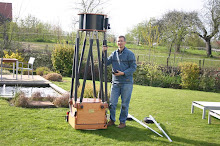
It has been a while (Oct 22) that I have been observing. Bad weather and other things on my mind have been the root cause. Finally, today Dec 25 it’s a very clear night.
Location: Boutersem (Belgium)
Equipment: Obsession 18”
Eyepieces: 24mm; 16mm, Powermate 2,5x
Nelm: 5,2
Seeing: moderate
Time 22Hr UT to 2 Hr UT
I started by observing M37 in Auriga. I like this cluster very much.
M1 - supernova remanent in Taurus
Next one is M1. Even with the 18” this object is quite disappointing. The shape is quite obvious with sharp edges and the centre is brighter than the edges. But there is no structure to see in this large object. I see no stars superimposed on M1.
NGC 1514 - planerary nebula in Taurus
NGC 1514 is a planetary nebula in Taurus. Without filter this object is almost not visible, but with filter, wow, this becomes a splendid view.
M77 - galaxy in Cetus
211x: M77 has a large core surrounded by a faint disc. It’s slightly oval. The disc does not reach until the bright star located east of M77. During one moment I had the impression to see faint spiral arms in the halo.
NGC 1055 - galaxy in Cetus
This galaxy is located NW from M77. At 124x I can see it as an elongated object of 4’. It is much thicker in the middle. At 211x the northern edge appears sharper than the southern one. It’s probably due to the dark lane.
NGC 1072 - galaxy in Cetus
This galaxy is located between M77 and NGC 1055. At 211 I can see a star and nebula during 20% of the time.
NGC 1090; 1087; 1094 - galaxies in Cetus
This trio is located south east from M77. At 211 NGC 1090 looks like an oval (elongation 3:1) of 2’. Visible 50% of the time. No core. NGC 1094 is an easy object. It’s a little oval smaller than 1’. It’s continuously visible. NGC 1087 is a large smudge, almost round, without any structure.
Hickson 16 (NGC 833; 835; 838; 839) – galaxies in Cetus
Hickson 16 is a quite easy group of galaxies in Cetus. At 124x I can see 3 members. NGC 835 is an easy object. NGC 835 is visible 50% of the time and NGC 829 is only now and then visible. The 4th member, NGC 833 becomes visible at 211x. At this power, I can see the core of NGC 835. NGC 839 remains difficult.
After these objects in Cetus I decided to go for some objects that Demelza described in her December targets.
NGC 1501: planetary nebula in Cameleopardalis
This is a splendid object at 211x. The central star is obvious. The edges are sharp. The northern edge appears brighter. The disc contains dark areas. Next time I need to see if I can see some color in there.
IC 3568: planetary nebula in Cameleopardalis
IC 3568 is another planetary in Cameleopardalis but much smaller than NGC 1501. It’s only 6” big. I can see it as a round bright little disc, close to a mag 13 star. Observation at 211x. No more details with a UHC filter.
IC 410 – emission nebula in Auriga
The nebula is well visible at 124x with an UHC filter. It’s a big one filling almost completely the field of view. I guess this one is larger than 25’. It looks like a C. Some of its edges are sharp; some other ones are more diffuse. The western part is brighter than the rest.
Stock 8 and IC 417 - open cluster and emission nebula in Auriga.
I tried to look for IC 417, another nebula in Auriga. First I thought it was some nebula around Phi Aur, a beautiful orange star. But what I saw was nothing else than glare. IC 417 is located in Stock 8, which is a quite loose open cluster of 20 stars located in an area of 20’. It difficult to say where the cluster starts or ends because it is so loose. Did I see IC 417? Certainly not without any filter. I have guessed it at 124x with an UHC filter, but I could not confirm it. Will need to repeat this observation.
Abell 8 – planetary in Auriga: not found
K 2-1 – planetary nebula in Auriga
The first successful observation in Deepskylog. The object is visible at 127x with UHC filter. Difficult to say what kind of shape it is. It looks irregular or oval and must be at least 2' big. Averted vision is of course needed to see it. 50% of the time visible. At least on star is visible on the nebula, and some others very close to it.
NGC 2242 – planetary nebula in Auriga
This planetary is not visible at 127x. I can see it at 211x as a very small disc. Averted vision is required to see this mag 15.2 object. An UHC filter gives a positive effect.
NGC 2392 (Eskimo) – planetary nebula in Gemini
A marvelous object at 316 with UHC filter. I could see the typical Eskimo image. An inner bright disc, with central star, is surrounded by a large but fainter outer shell. The inner disc has a kind of triangular shape, which is so typical on pictures of the nebula. Next time I need to look for colors and for the concentric ring within the inner disc.
M35 and NGC 2158 – open clusters in Gemini
Marvelous. For the first time I can completely resolve NGC 2158. At 211 I can see something like 20 stars in this little OC.
Rosette – emission nebula in Monoceros.
Again, marvelous! I can clearly see the nebula cover its complete circumference. The background of the centre is completely dark and filled with many stars of NGC 2244, the open cluster. The nebula is wider and brighter at its northern edge. I can see many brightness is differences in the nebula. To see its full splendor, this object should be seen with an eyepiece that provides a larger field of view.
Xmas tree – could not see the nebulosity.
I continued the night with some classics such as M42 and M43. Again these are splendid objects in the 18” scope. M42 was clearly mottled and contained many details. Also M43 was spectacular. Also spend some time on the flame nebula (NGC 2024). Also I tried to look for the Horsehead nebula with an UHC filter. I had the impression to see some nebula (not the Horsehead itself) but cannot confirm it.
NGC 2359 (Thor’s helmet) – emission nebula in Canis Major
The object was still low in the sky, but nevertheless it was already nice to look at. The typical shape was clearly to see at 211x and UHC filter. The nebula consists of 2 segments; the southern one is an elongated patch going west to East. The northern segment is almost a full circle. The northern part of the circle is the brightest one.
I ended the night with M82 (beautiful), M81 and M97.
Friday, December 26, 2008


Sunday, May 25, 2008
Observations May 2008
It has been a while I have been posting some observations, but it does not mean I have been inactive. On the contrary, I have been observing a few times during May with my Obsession 18".
Here thhey are. Let's start with Friday May 2, 2008
Location: Boutersem
Equipment: Obsession18”
Eyepieces: 24mm; 16mm, Powermate 2,5x
Nelm: less than 5.0
Seeing: moderate
I decided first to increase a bit the pointing accuracy of the telescope. Argo Navis has a feature to do so with “Alt ref”. It means that you fine tune the angle at which the scope is aiming at Zenith. After a few alignments I seems that this angle is 89°71.
I started to look for M3 and M51 which is of course beautiful.
Hickson 44 – galaxies in Leo
At 127x (this is the 16mm eyepiece) I can see NGC 3193 with direct vision. It contains a stellar core, is almost round and I estimate it to be 2’ long. NGC 3190 is an elongated galaxy with a core – it’s 4’ long. I could not see the 2 other galaxies.
M100 – galaxie in Coma.
Did not really take notes of M100, but at 127x I could see NGC 4311 which is located near a double star. No core visible in the galaxy. NGC 4379 is a round smudge of 3’ and like the other I can’t see any core.
Next day I could also get the socpe out to observe . So here is what I saw on Saturday May 3, 2008
Location: Boutersem
Equipment: Obsession18”
Eyepieces: 24mm; 16mm, Powermate 2,5x
Nelm: better than 5.0
Seeing: moderate
M106 – galaxie in Ursa Major
This galaxy contains many HII regions which I wanted to look for. NGC 5471 is the brightest one and is located at the east side of M106. It is clearly visible at 84x as a round smudge. With an UHC filter NGC 5471 becomes very bright and is visible with direct vision. NGC 5477 is not visible at 84x.NGC 5461 and 5462, also at the east side of M106, is now and then visible with averted vision (84x with UHC). They seems larger than NGC 5471 but are much fainter. At the other side of the galaxy a few other HII regions becomes visible at 127x and with the use of an UHC filter. NGC 5450 and 5047 is visible as a long smudge. I can see it almost continuously with averted vision. NGC 5455, located at the south of M106 is a small smudge of light, not continuously visible.
Hickson 44 – galaxies in Leo
Yesterday I could see only 2 objects of Hickson 44, today I can add a 3rd one which is NGC 3185. At 211x NGC it’s a faint large oval smudge with a stellar core. Averted vision is required to see the galaxy. NGC 3193 is almost round and contains a large bright core. NGC 3190 is an elongated nebula with a core. It’s in same FOV as 3193. The 4th galaxy was not visible.
Hickson 61 – galaxies in Coma
The 2nd Hickson group of the evening; At 84x I can see easily NGC 4169 as an oval of 2’. NGC 4174 is visible now and then, with it’s 1’ it’s smaller than the previous one.
At 127x I can see continuously both galaxies and in addition NGC 4175 becomes visible as an elongated patch of light. The elongatin direction is NW-SE.
NGC4 173, the other elongated galaxy of Hickson 61 is not visible.
Coma Cluster (NGC 4874)
This is an area with a huge number of galaxies. At 127x is can see: NGC 4889: almost round – 2’ with a stellar core. NGC 4898 – round object less than 1’ large, no core. NGC 4874: round, fainter than 4889 – 1’ and again no core. At 211x a few other galaxies becomes visible: NGC 4869 – round – visible once in a while. NGC 4864 – round and also visible once in a while. NGC 4860 and 4865: these are 2 difficult objects – serious averted vision is required to see them – they are both round and around 0,5’ small. NGC 4886 is probably seen too.
NGC 4147 – globular in Coma
At 211x I can see some stars at the edges of the globular. The core is granular.
M97 – owl nebula in Ursa Major
At 316x and OIII filter I can see one eye, maybe the 2nd one. It’s a large disc with a brighter area at the east side.
M108 – galaxie in Ursa Major
Located near the owl. The dust lane is visible.
M57 – planetary in Lyra
Marvelous – the centre is filled with faint haze. Central star is not visible.
M13 –globular in Hercules
What can I say – this is breath taking.
Other globulars were M92 and M56. M92 is also a fabulous object in the 183.
This ends a very nice observation session.
2 days later it was once more clear. Monday May 5, 2008:
Location: Boutersem
Equipment: Obsession18”
Eyepieces: 24mm; 16mm, Powermate 2,5x
Nelm: 5,3
Seeing: moderate
Neighborhood of M99 – galaxy in Coma
NGC 4262, located north of M99 is an easy object at 84x. At 211x it is round with a very bright core.
M99 itself is a large object. It has a halo of 4’ which contains a core of an irregular shape. The core is around 2’ large. The halo seems circular and of equal brightness. I suspect a spiral arm at the west side.
IC 781 suspected at 84x but for sure seen at 211x. A smudge of 2’
NGC 4298, located east of M99 is a large oval at 84x. It’s 3’ and no core is visible. It’s located west of a faint star.
NGC 4302 is visible now and then. It’s an elongated object similar to a “cigar”. Maybe 2 times larger as NGC 4298.
At 211x NGC 4298 seems to have a core. A bright patch is visible in the galaxy. NGC 4302 remains equal in brightness.
Neighborhood of M100 – galaxy in Coma
At 211x M100 has a large core of 2’ and is irregular of shape. The core is surrounded by a halo of 6’ where 2 hints of spiral arms are visible.
NGC 4328; east of M100 is not continuously visible. It’s too faint to defite its shape.
NGC 4322 was not visible.
NGC 4567 – Siamese Twins in Virgo
Beautifull! I still remember this when I saw it in the Provence with my 20cm. Now the view is totally different and better. I see easily 2 large ovals coming together in a V-shape. Both have a core. The eastern galaxy (NGC 4568) is the largest one.
In the same fov I can see NGC 4564 as an almost round nebula with a large halo and a bright core.
West of the twins is NGC 4528 which is, at 82x an almost round smudge of light of 1’ with a core. It’s located next to a straight line of 4 stars. A bright orange stars is also visible. At 211x a star superimposed on the core becomes visible.
IC 3499 is not visible at 82x but rather at 211x. It’s an oval of 1, has no core and it needs averted vision to see it now and then.
M64 – blackeye galaxy in Coma
The dust line is visible with direct vision and is clearly not straight line.
M104 – Sombrero galaxy in Virgo
The dust line is clearly visible as a dark straight area, but the nebula south of this line is not visible. Maybe because the galaxy is already quite low in the sky.
And again, the next day it was clear. Unbelievable for Belgian standards.
Tuesday May 6, 2008
Location: Boutersem
Equipment: Obsession18”
Eyepieces: 24mm; 16mm, Powermate 2,5x
Nelm: 5,0
Seeing: moderate
NGC 2903 –galaxy of m9.0 in Leo
Large nebula of 8’ with a big bright core. The halo at the NE side is brighter and longer (211x)
NGC 2916 –galaxy of m12.1 in Leo
Is located close to NGC 2903. With averted vision this is almost a round object of 1’. No core. Located north of a faint star
Copeland Septet –galaxies in Leo
Copeland Septet is not visible at 84x. At 211 I can see 2 galaxies. NGC 3753 is almost continuously visible. It’s a round smudge without core. Perhaps NGC 3756 is visible; The other one, NGC 3746 is visible 50% of the time.
NGC 3758 –galaxy of m? in Leo
Located south of Copelands Septet. At 211x this is a round smudge of 1’ without any core. It’s located between 2 moderately bright stars.
NGC 3808 –galaxy of m? in Leo
This galaxy is located 50’ NE of Copelands septet. A round smudge, with averted vision visible for 50% of the time. No core.
PGC 83477 – galaxy of m in Leo
This galaxy is located 10’ South of Copelands Septet. At 211x this galaxy is almost continuously visible with averted vision.
You would think this is enough. No, 2 days later again a clear night. Thursday May 8, 2008
Location: Boutersem
Equipment: Obsession18”
Eyepieces: 24mm; 16mm, Powermate 2,5x
Nelm: 5,0
Seeing: moderate
Since now I’m equipped with a very dark cloth to protect myself from streetlights. It’s working very well if can avoid dew on the eyepiece
Copeland Septet – galaxies in Leo
With the dark cloth I’m trying once more Copeland Septet. This time I can see 6 galaxies (316x), whereas I could see only 4 the previous time. NGC 3753 is easy. NGC 3750 and 3754 are not continuously visible. NGC 3746 is now and then visible but rather obvious. NGC 3748 and 3751 are very difficult objects. It’s visible for maybe 10% of the time, but I’m certain to have seen it.
Abell 1367 – galaxies in Leo
This is a group in Leo containing many galaxies. At 84x I can see 4 galaxies.
- NGC 3861 is almost round, 2’ and contains no core.
- NGC 3842 located close to a bright star – round – easy – 2’ large. The core is visible at 211x.
- NGC 3837 is also easy to see. It’s 1’ and again no core. A core is visible at 211x.
- NGC 3860 is not always continuously visible. It’s round and is 2’ long. I could not see NGC 3860A, even at 211x.
At 211x more galaxies become visible:
- NGC 3845 is visible with averted vision – no core.
- UGC 6697 is also visible, without any core.
- NGC 3840 is very difficult – looks like a round object.
- NGC 3844 is now and then visible as a elongated smudge but without any core. The elongation is NE-SW.
- PGC 36589 is a round object smaller than 1’. No core and not continuously visible.
M97 – owl nebula – Uma
At 211x and without filter only 1 eyes is visible. The central star is however visible at this magnification. With an UHC filter the 2nd eye becomes visible. The 2nd eye is a difficult observation in mag 5.0 skies. Anyway, the view is really great, some parts of the nebula is brighter than the rest.
OK time for a break now.
Friday May 23, 2008
Location: Boutersem
Equipment: Obsession18”
Eyepieces: 24mm; 16mm, Powermate 2,5x
Nelm: 4.7
Seeing: moderate
Today it’s not perfectly clear but it has been a while I observed. I'm motivated enough to take everything out in the garden.
NGC 3079 – galaxie of m10.9 in Uma
Nice galaxy of 5’ long. 2 faint stars are located next to the galaxy. Another star at the northern tip. The centre looks a bit more larger. Searched for NGC 3073 (m 13.4) but could not see it.
Arp 313: NGC 3995 (m12.4) – 3994 (m12.7) – 3991 (m13.1) – galaxies in Uma
This is a nice trio (arp 313) of galaxies in Uma. At 84x I can see only NGC 3995 and NGC 3994. NGC 3991 becomes visible at 211x. NGC 3995 is the largest one (2’). It is oval and has no core. It’s continuously visible with averted vision. NGC 3994 is smaller but brighter than 3995. It’s round and has a bright core. I can see it continuously with direct vision. NGC 3991 is almost round and has no core. It’s a large as NGC 3394 but I can see it only 80% of the time. Those galaxies are located east of a bright start which is slightly orange.
NGC 4013 – galaxy of m11.2 in Uma
It’s a nice galaxie which is more than 4’ long. It seems to have a bright core but in reality it’s a foreground star. The dustlane was not visible.
Closed the observation session with M57; M13, M56.
I'm getting more and more used to the Obsession. Hopefully the next clear night is not long from now.
Clear Skies
Olivier
Thursday, May 1, 2008
Observation March 30, 2008
This is my first observation report with my Obsession 18”. It will contain a list of observed objects with minimal explanations, as I’m still learning to use the scope and have not yet the patience to write everything down.
Location: Boutersem (Belgium)
Equipment: Obsession 18”
Eyepieces: 24mm and 16mm - Powermate 2,5x
Limit Magnitude 5.0
Seeing: moderate
Time from 21:00 UT to 24:00 UT
M51 – galaxy in Canes Venatici
The 2 spiral arms are well visible at 127x (16mm). I can see 3 stars superimposed on the galaxy. This is a very nice DSO
M101 – galaxy in Ursa Major
At 127x I can see several (at least 3) HII regions. Not sure if I have seen the spiral arms (as such). I need to learn to look for details and shapes, something I’m not used too. With my 8” scope the aim was to find faint objects – it was rarely the case that lot’s of details were visible. I have to acquire a new skill!
NGC 4631 (The Whale) and NGC 4656 (the Hockeystick) – galaxies in Canes Venatici
Magnificent. At 127x the whale takes more than half of the FOV of 38’. The shape is clearly recognisable. Also baby whale (NGC 4627) is clear visible as a “large” objects.
Same comment concerning the shape for the Hockeystick. I can clearly see the shape like on photographs. The brightness is not equal across the object. There is a brighter zone at the NW side.
M3 – globular in Canes Venatici
Again, a show piece. At 211x (24mm + 2,5 Barlow). Stars are well resolved, also in the core.
M64 – Blackeye – galaxy in Coma
At 127x the dark lane is clearly visible, even with direct vision.
M53 and NGC 5053 – globulars in Coma
M53 is a very nice object. Again plenty of stars visible at 211x. NGC 5053 is a difficult object. I have seen this one with my 8” in the Provence. Here with my 18” I can hardly see it.
NGC 4565 – edge on galaxy in Coma
Again a showpiece. At 127x the dust lane is visible. Again not easy for me, as this is the kind of things I need to learn to look for. But I can see it already better than 1 week ago.
Markarian Chain – galaxies in Coma
I really like this chain of galaxies. Today’s objective is just to find as many galaxies as possible, without really noting downs the details I could see. So here is the list that was visible at 127x: NGC 4305, 4306, m84, m86, 4402, 4387, IC3303, 1388, 4413, 4425, 4438, 4435, 4461, 4458, 4473, 4479, 4477, 4506. So 18 galaxies! There are probably more visible at higher power, but that’s something for next time.
NGC 4874 – Coma Galaxy cluster
At 127x I could see 4874, 4869, 4889 and 4898. Wanted to see more of them, but the Argo Navis had an issue, and tracking was disable. So I stopped observing at 00:00.
This was my 5th observation session. It’s really a good scope. Also the GOTO is working well as long as the 2 alignment stars are in the neighbourhood of the objects you’d like to see. But as aligning is a very quick process (much quicker than on my previous scope) it’s really not an isse.
Wednesday, April 23, 2008
"2nd" light with the 18" Obsession
Yesterday evening I had my "2nd light" with the Obsession. Again a nice success, as the tracking and the goto were performing well this time. The issue was just the ArgoNavis cable, it was not fully plugged in the ServoCat. So problem solved - all works well.
The speed of the Goto is amazing. Much faster than with my 20cm Newton. Also, with a Dob you don't have the issue of crossing the meredian, something I continuously faced with my Newton on a German mount.
The accuracy of the goto is not bad, all object were in a FOV of 30'. But it can still improve with some of the AN functionality. Something I will have to find out by reading the manual.
I'm still not very confident in moving the scope fully assembled (with UTA). I use the red spring clamps to hold everything tight, but I'm not yet sure if this is totally OK. For now I prefer to observe close to my home. But there I have quite some issues with a street light. Once I'm more confident I'll move at the back of my garden, it's much darker there.
Today I had also dew on the secondary. I did not fix the dew heater yet (not sure which type of glue I need) but I feel the pressure now to do it quickly. Unfortunalty, the whole weekend I'm out, so it will be something for in 10 days.
So far the technical stuff. In terms of observation I limited myself to the classical objects (using goto) such as M3, M51 (spiral arms visible), M81/82, the Whale, M65/M66, M65, Markarian Chain and BlackEye. Naked Eye Limit Magn was 4,5, maybe 5.0 at the end of the session.
After something more than an hour observing clouds were appearing (at the same time as the dew ...).
As a conclusion: everything works well (it's a relief), and now I need to increase the observing comfort and start to migrate at the back of my garden.
Ckear skies to all of you
Olivier
Sunday, April 20, 2008
First light with Obsession 18"
Last week Thursday my 18" Obsession arrived at home. I ordered it directly from Obsession. I have spend a few hours to assemble it, and had kind of a first light on Friday. I could see the moon behind the clouds. As such not very spectacular, but it was my first look through my Obsession.
On Sunday I installed the ServoCat and ArgoNavis. And finally, in the evening it was more or less clear for an hour or so. At least clear enough to test the scope. And it was a success.
The first object was Saturnus. Woow - so much bigger than with a 20 cm scope. Then Mizar-Alkor. What a difference with my previous scope. Star images where pin point sharp.
Then I've set up the Argo-Navis. It worked!. M3 was really amazing - so many stars (it's not even completly dark). Then M81, M82 (woow). M36, M37 (very nice) and M36. At that moment the sky was completly covered by clouds. I still wanted to hunt M3 in an open area, but sadly one of the encoders was slipping.
What did not work was tracking. The scope was not tracking the objects, so I had to adjust manually. I need to go through the manual to see how this works.
Anyway, It was a successfull first light. I did not expect the Argo-Navis would work that easily from the start.
Clear Sky
Olivier
Saturday, February 16, 2008
Observation February 10, 2008
It’s again a nice sky this evening. I wanted to look back to the supernova in NGC 524. Yesterday evening I was looking at the wrong place. So this time I printed out a picture of NGC 524 together with its surrounding stars and the supernova. I could first not see it but after a while, when my eyes were well adapted to the dark, I found it at 156x. It was visible for around 20% of the time; this to say that it was not that easy. It's the first supernova I see !!
After this nice achievement I decided to do some planetary nebulas.
Location: Boutersem (Belgium)
Equipment: Celestron Advanced Newton 20cm F5
Eyepieces: 24mm and 16mm - Powermate 2,5x
Limit Magnitude 5.0 to 5.3
Seeing: moderate
Time from 19:00 UT to 21:00 UT
IC 3568 – baby Eskimo – planetary nebula of mag 10.4 in Camelopardalis
At 64x I can see a small disc. The object forms a triangle with 2 other stars which are fainter than the nebula. It reacts very well on a OIII filter. Ay 154x the disc becomes very obvious. I can see a bright core surrounded by a dimmer edge. No more details with a OIII filter.
PK 147+4.1 - planetary nebula of 10” of mag 13.8 in Camelopardalis
Not visible at 64x nor at 154x. But with an UHC filter it becomes visible after a while (154x), so the nebula reacts with a slow response time to a filter. I can see now and then a small disc. Afterward I could see the nebula also without filter.
PK 147-2.1 - planetary nebula of 7” of mag 13.4 in Perseus
Not visible at 64x nor at 154x without filter. At 154x with UHC I can see a stellar object with averted vision. It’s visible 80% of the time.
PK 131-5.1 - planetary of mag 14.8 in Perseus: not visible at any magnification
PK 198-6.1 - planetary of mag 12.2 in Orion: not visible
PK 197-14.1 - planetary of 57” of mag 13.9 in Orion
At 104x with UHC it’s visible 50% of the time as a very faint disc.
NGC 2022 - planetary of 32” of mag 11.5 in Orion
I can see a disc but the ring (so the dark centre) is not visible (154x)
Flame nebula
This was like yesterday well visible at 64x with UHC filter.
This was 2 hours well spend. Happy to have seen 4 new planetary nebulas (I had observed NGC 2022 already once in 2005)
Clear skies
Sunday, February 10, 2008
Deepsky observation on Feb 9, 2008 with Jan Vanautgaerden
According to the weather forecast, Feb 9, 2008 was the warmest day ever on a Feb 9 in Belgium. It was indeed a very nice day with temperatures around 16,5°C.
The night was clear too, although a lot colder. I have been observing together with Jan Vanautgaerden, a very active deepsky observer from Belgium. Jan brought his 15” Obsession with him (lucky me). We have been observing in the fields of Boutersem, on a place where we are not bothered by streetlight and where on top the sky is completely free towards the south.
Transparency was very good, probably close to mag 5.5. I have been observing with my 20cm Newton but did not take notes this time. So all this is based on memory …
All observations are with the 20cm except otherwise noted.
NGC 524 – galaxy of mag 10.3 in Pisces
We started by observing NGC 524 where a supernova has been detected. We used the 20cm scope, not the Obsession because it was not yet installed. Unfortunately, I thought the supernova was in the centre of the galaxy. Apart from the core nothing was visible there. The truth is that the supernova is lying more NE from the visible edge. Need to repeat this for next time. The galaxy itself is not that easy at 64x. 154x is the optimal magnification. Now the galaxy is an easy target, oval and the core is visible. BTW, NGC 524 is a Herschel I (one) object.
I tried to do some Herschel II objects in Eridanus, but nothing was visible.
NGC 2366 – galaxy of mag 10.5 in Camelopardalis
This is also a Herschel II object. A few weeks ago I was not able to see it from my garden, but this time I got it. Not at 64x but at 104x. It’s a long smudge SE of a faint star.
I have to admit that Herschel II list is not getting me really motivated for the moment. It’s really too much at the edge of what I can see with my scope. It’s nice for a while, but not for every night. So what I’ll probably do is to continue Herschel II one in a while between some other observations. So I decided to continue with some other stuff.
Perseus A cluster – NGC 1275 – galaxy in Perseus
NGC 1275 is easily visible at 104x. Also NGC 1278 was visible. I could not detect NGC 1272.
NGC 2359 – Thor’s Helmet – Canis Major
This one I have observed with my own scope and with the 15” Obsession. Thor’s Helmet is a favourite object of Jan. It’s a real nice object which is not really known, maybe because M42 is in the close neighbourhood. With my scope I could almost see a complete circle, together with a part going from east to west. This was of course much more obvious in the 15” scope, where the complete disc became visible. Observation was done with an OIII filter.
NGC 2362 - open cluster in Canis Major
This is a very nice cluster lying around the bright star Tau Cma. Lot’s of fainter stars visible.
We tried to look to Sirius B with the Obsession. Sirius B is around 8” separated from Sirius A. It was not visible. We did not try that hard, though.
Another double star is Rigel, also at 8”. This was separated at 154x with the 20cm scope. Forgot to note the colours.
Orion Nebula M42 and the Trapezium
A beautiful object in the Obsession. We could see with this scope the 6 stars in the trapezium. But also with the 20cm scope we managed to see the 6 stars at 156x. I had seen already 5 stars with my scope but never 6 stars. Mission accomplished today!
NGC 1999 – emission nebula in Orion
Special object. Impressive with the Obsession. A bright circular part, a darker centre, and again a brighter part. With the 20cm scope we could see the 2 bright parts at 154x.
NGC 2024 – Flame nebula in Orion
Observed with the Obsession. Quite strange because it was better visible without filter than with filter. The opposite was true for the 20cm scope. Where the two parts were visible with an UHC filter
NGC 2237 - Rosette Nebula in Monoceros
Again, beautiful with the Obsession. Almost the whole ring was visible with an OIII filter. But also without the aid of any filter, the object was visible. Here also I could see it easily with filter with my scope. Several parts of the ring became apparent. I’ve never seen it so well with my scope. Truly a very good observing session.
NGC 2264 - Xmas Tree in Monoceros
I never succeeded to see the nebula with my scope, but Jan has already seen this one in La Palma. So he knows well where to look, ie at the base and East of it. The issue with the base is the presence of glare, so we were never sure if we have seen some nebula there. We think we have seen some nebula at the east side but I don’t think both of us would put our hand in the fire for it.
Now we went to the other side of the sky, direction Ursa Major
M81 – M82 – galaxies in Ursa Major
M81 and M82 are impressive in the Obsession. We tried to look for the spiral arms of M81 but without success. M82 was also not bad at all in the 20cm. The dark lane was easy.
M92 – planetary in Ursa Major
One eye visible with the 20cm (without filter). It’s very nice in the Obsession where more structure is visible. Probably 2 eyes visible.
We aimed also the 15” to the trio of galaxies in Leo (M66, M65, NGC 3628). Amazing! We ended the night around 1am with observations of M51 (the spiral arms were visible in the 15”), the Whale (with the 20cm) and the Hockeystick, which was very difficult to find with the 20cm. The very last object was M64 where we could see the dark lane with the 20cm.
So although I took a break concerning the Herschel II list I had a very nice observing session together with Jan. It’s very nice when you can observe with a “buddy” and talk about what you see. And comparing views with 2 very different scopes is fun too.
Clear skies to all of you.
Subscribe to:
Posts (Atom)