Estimated magnitude: 12.6 (FWIW ...)
Jan 29, 2011 - around 22:00 UT
Sky conditions not very good, limiting magnitude below 5.
Sunday, January 30, 2011


Saturday, January 29, 2011
I want to see Supernova SN 2011B in Cameleopardalis – 28 Jan 2011
It’s cold tonight, but I haven’t been observing a lot lately, so here we go, together with Jan, observing in Boutersem. The sqm shows 20,03 at the start of the session, gradually improving to 20,12 at the end of the night.
I have a twofold objective for this night, first it’s to catch the supernova in Cameleopardalis, and then the last 2 Herschel II galaxies in Eridanus.
Location: Boutersem
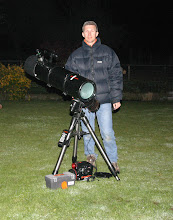
Equipment: Obsession 18”
Eyepieces: 31mm Nagler, 13mm, 7mm and 5mm Nagler (all from Jan)
Nelm: above 5,0
Seeing: good
SN 2011B in NGC 2655 – galaxy in Cameleopardalis
An easy one. Immediately visible at 123x, even with direct vision, just outside the halo of NGC 2655. NGC 2655 has a bright core and a quite large halo. At 211x the galaxy shows also a stellar core. The supernova is still located just outside the halo. According to what I read on fora the magnitude is 12.5.
This is my 3rd supernova. Here is a summary of the ones I have seen:
•SN 2008Q NGC 524 Psc Feb 2008 observed with 8" Newton
•SN 2009dd NGC4088 Uma Apr 2009 observed with 18" Obsession
•SN 2011B NGC 2655 Cam Jan 2011 observed with 18" Obsession
The first objective is accomplished. But not the 2nd one ! The objects (NGC 1187 and NGC 1325) were already to low at the horizon, I’m too late !!! Culmination is at 7pm, and it’s now close to 10 pm. Bad planning … But there is hope, tomorrow the weather forecast looks good so I’ll try it again.
NGC 2359 - Thor’s Helmet – nebula in CMa
I’m always surprised how faint this object is. You need to take your time to see all kind of details. The first horn is easy to see. Jan saw the 2nd horn first and after some attempts I could see it too.
NGC 1999 – emission and reflection nebula in Ori
This is an overlooked object for obvious reasons (close to Orion nebula). Nevertheless it’s a nice object. It looks like a planetary nebula with a central star but It’s not. The very nice aspect of this nebula is the a black area, like a bite in a cookie, very similar to a partial sun eclipse.
Rosette nebula in Monoceros
Beautiful. The FOV of 31mm Nagler is almost completely filled by nebulosity, except the centre which is darker. The nebula is visible over the entire 360° with some area’s brighter than others.
NGC 2261 - Hubble Variable Nebula in Monoceros
Again an impressive site. The typical shape of this nebula is clearly visible. The brightest part is around the star, and then it fades slightly. Next time I’ll spend more time to look for more details.
M42 – Orion Nebula
Great, for the first time I could see a greenish color at the nebula just south of the trapezium (without using a filter). Observed at 155x (7mm Nagler).
NGC 2683 , galaxy in Lynx.
This is an fairly large galaxy in Lynx. Probably 8’ long. The surface is mottled. And a short dark lane at East side is pretty well suspected.
We have also seen
M46 and the planetary nebula, which reacts very well with an UHC filter.
Eskimo nebula,
NGC 2371/72,
M82 (Wow!!), M81 (but we could not see the spiral arms).
We ended a bit before midnight, more due to the cold than anything else. The sad thing about this place is that light pollution is getting worse, especially at the east side which is Tienen. This was not like that 2 years ago. I suspect it's primarily coming from the chemical industry there. Something to study more in detail and evaluate if actions can be taken. To be continued!
I have a twofold objective for this night, first it’s to catch the supernova in Cameleopardalis, and then the last 2 Herschel II galaxies in Eridanus.
Location: Boutersem
Equipment: Obsession 18”
Eyepieces: 31mm Nagler, 13mm, 7mm and 5mm Nagler (all from Jan)
Nelm: above 5,0
Seeing: good
SN 2011B in NGC 2655 – galaxy in Cameleopardalis
An easy one. Immediately visible at 123x, even with direct vision, just outside the halo of NGC 2655. NGC 2655 has a bright core and a quite large halo. At 211x the galaxy shows also a stellar core. The supernova is still located just outside the halo. According to what I read on fora the magnitude is 12.5.
This is my 3rd supernova. Here is a summary of the ones I have seen:
•SN 2008Q NGC 524 Psc Feb 2008 observed with 8" Newton
•SN 2009dd NGC4088 Uma Apr 2009 observed with 18" Obsession
•SN 2011B NGC 2655 Cam Jan 2011 observed with 18" Obsession
The first objective is accomplished. But not the 2nd one ! The objects (NGC 1187 and NGC 1325) were already to low at the horizon, I’m too late !!! Culmination is at 7pm, and it’s now close to 10 pm. Bad planning … But there is hope, tomorrow the weather forecast looks good so I’ll try it again.
NGC 2359 - Thor’s Helmet – nebula in CMa
I’m always surprised how faint this object is. You need to take your time to see all kind of details. The first horn is easy to see. Jan saw the 2nd horn first and after some attempts I could see it too.
NGC 1999 – emission and reflection nebula in Ori
This is an overlooked object for obvious reasons (close to Orion nebula). Nevertheless it’s a nice object. It looks like a planetary nebula with a central star but It’s not. The very nice aspect of this nebula is the a black area, like a bite in a cookie, very similar to a partial sun eclipse.
Rosette nebula in Monoceros
Beautiful. The FOV of 31mm Nagler is almost completely filled by nebulosity, except the centre which is darker. The nebula is visible over the entire 360° with some area’s brighter than others.
NGC 2261 - Hubble Variable Nebula in Monoceros
Again an impressive site. The typical shape of this nebula is clearly visible. The brightest part is around the star, and then it fades slightly. Next time I’ll spend more time to look for more details.
M42 – Orion Nebula
Great, for the first time I could see a greenish color at the nebula just south of the trapezium (without using a filter). Observed at 155x (7mm Nagler).
NGC 2683 , galaxy in Lynx.
This is an fairly large galaxy in Lynx. Probably 8’ long. The surface is mottled. And a short dark lane at East side is pretty well suspected.
We have also seen
M46 and the planetary nebula, which reacts very well with an UHC filter.
Eskimo nebula,
NGC 2371/72,
M82 (Wow!!), M81 (but we could not see the spiral arms).
We ended a bit before midnight, more due to the cold than anything else. The sad thing about this place is that light pollution is getting worse, especially at the east side which is Tienen. This was not like that 2 years ago. I suspect it's primarily coming from the chemical industry there. Something to study more in detail and evaluate if actions can be taken. To be continued!
Saturday, January 15, 2011
FINALY A CLEAR NIGHT – 9 Jan 2011
Slowly but surely I’m getting out of my observation burn out. I’m starting to read again about astronomy, spending time of forums. I’m even going to give a presentation to Urania: “Ik heb het Messier certifiicaat, wat nu?” And after so many grey days and night we have finally a clear sky – let’s go for it!
Location: Boutersem
Equipment: Obsession 18”
Eyepieces: 24mm; 16mm, Powermate 2,5x
Nelm: above 5,0 but certainly not 5,5
Seeing: good
The idea of the evening is to finish the Hershel II objects in Eridanus. But first some easy things to start with:
Jupiter
M36, M37, M38
M1 – at 211x quite some stars to see close to the edges.
NGC 40: central star, bright edges, star close one of the edges. One of my favorites.
The messiers in Orion: M42, M43, M78
Following objects are from Herschel II catalogue.
NGC 1187 – galaxy in Eridanus
Could not see it !! Also not after 2nd attempt!
NGC 1325 – galaxy in Eridanus
Could not see it !! Also not after 2nd attempt!
I already know I will not meet my objective.
NGC 1332 – galaxy in Eridanus
124x - elongated galaxy of 2' with a bright large core. Not an easy object due to low position.
NGC 1353 – galaxy in Eridanus
124x - elongated galaxy of 2' x 1' -difficult to seen, I can's see it continuously. A star visible south of the elongation direction.
NGC 1400 and NGC 1407 – galaxies in Eridanus
124x - round spot of 1' with a bright stellar core. NGC 1407 is larger and brighter than NGC 1400. It's 2' long and contains also a stellar core. Could not see IC 343 and NGC 1402, even at 211x
NGC 1507 – galaxy in Eridanus
124x probably seen as an elongated smudge of 3'
21x It remains diffuclt but I can confirm it as an object of 3' x 1'. It has a uniform visibility. There is a faint star located 2' from its west side. Observation becomes a bit easier while using a dark cloth as I can see it now during half of the time. A superimposed star is suspected.
Next one is not Herschel II, but nice little planetary in Orion
NGC 2022 – planetary nebula in Orion
211x - planetary nebula in Orion - at this power I the disc is elongated and I can see a slightly darker centre (as a ring). No central star but I suspect a faint star on its northern edge. I googled some images of NGC 2022 and indeed, there is a star there. Also Tom Polakis is mentionning this star.
Ended the night with planetaries such as M76, NGC 1514 (Taurus), NGC 1501 (Cameleopardalis), NGC 2392 (Eskimo), NGC 2371/72 (also in Gemini).
Have seen now 390/400 Herschel II objects.
Location: Boutersem
Equipment: Obsession 18”
Eyepieces: 24mm; 16mm, Powermate 2,5x
Nelm: above 5,0 but certainly not 5,5
Seeing: good
The idea of the evening is to finish the Hershel II objects in Eridanus. But first some easy things to start with:
Jupiter
M36, M37, M38
M1 – at 211x quite some stars to see close to the edges.
NGC 40: central star, bright edges, star close one of the edges. One of my favorites.
The messiers in Orion: M42, M43, M78
Following objects are from Herschel II catalogue.
NGC 1187 – galaxy in Eridanus
Could not see it !! Also not after 2nd attempt!
NGC 1325 – galaxy in Eridanus
Could not see it !! Also not after 2nd attempt!
I already know I will not meet my objective.
NGC 1332 – galaxy in Eridanus
124x - elongated galaxy of 2' with a bright large core. Not an easy object due to low position.
NGC 1353 – galaxy in Eridanus
124x - elongated galaxy of 2' x 1' -difficult to seen, I can's see it continuously. A star visible south of the elongation direction.
NGC 1400 and NGC 1407 – galaxies in Eridanus
124x - round spot of 1' with a bright stellar core. NGC 1407 is larger and brighter than NGC 1400. It's 2' long and contains also a stellar core. Could not see IC 343 and NGC 1402, even at 211x
NGC 1507 – galaxy in Eridanus
124x probably seen as an elongated smudge of 3'
21x It remains diffuclt but I can confirm it as an object of 3' x 1'. It has a uniform visibility. There is a faint star located 2' from its west side. Observation becomes a bit easier while using a dark cloth as I can see it now during half of the time. A superimposed star is suspected.
Next one is not Herschel II, but nice little planetary in Orion
NGC 2022 – planetary nebula in Orion
211x - planetary nebula in Orion - at this power I the disc is elongated and I can see a slightly darker centre (as a ring). No central star but I suspect a faint star on its northern edge. I googled some images of NGC 2022 and indeed, there is a star there. Also Tom Polakis is mentionning this star.
Ended the night with planetaries such as M76, NGC 1514 (Taurus), NGC 1501 (Cameleopardalis), NGC 2392 (Eskimo), NGC 2371/72 (also in Gemini).
Have seen now 390/400 Herschel II objects.
Monday, August 17, 2009
Found Pease 1! And tested some nice eyepieces (16 August 2009)
Again a nice & clear sky, the 3rd in a row. I don’t need to work tomorrow so no worrying about staying late.
I have tonight also the opportunity to test some eyepieces (thanks to Hubert). I have an Astrolan ultrawide 30mm (80°) which provides me with a FOV of 1,2°, as well as a 9mm Nagler T6 and 4.8mm Nagler (the discontinued version)
It’s not totally dark when I’m starting to test them. But that’s ok as I’m doing some side by side comparison.
1. The first object was M13:
Astrolan 30mm (68x) vs. Pan 24mm (84x)
- A great FOV with this Astrolan (1,2°), much larger than the Pan (46’). But of course at the expense of a smaller magnification
- I have astigmatism with the Pan, but even more with the Astrolan. However, it disappears completely when I’m putting my glasses on.
- A bit of (vignetting). Don’t know how to translate in English
- Good eyepiece for starhopping (see later in this report)
9mm Nagler vs. 9mm Celestron Plossl (225x)
- Nagler is providing sharper stars than the Plossl
- But the Plossl goes slightly fainter!
- The FOV of 35' is just great
9mm Nagler vs. 9mm Celestron Plossl combined with Powermate 2,5 (563x)
The Nagler provides again sharper stars, but also here the Plossl goes fainter.
4,8mm Nagler (422x) (not compared with another eyepiece)
Sharp images, even at this power! Comfortable FOV of 20'. This is a great eyepiece!
Note 1: while testing I did not know this was a discontinued version and that the 5mm Nagler T5 provided a twice as large FOV. In fact, it's good I did not know, because it provides an unbiased opinion on this 4.8mm eyepiece.
Note 2: I found on Cloudy Nights quite some remarks on the short eye relieve of this eyepiece. I don't recall having been confronted with this issue during my testing. It's true however it's impossible to observe through this eyepiece with glasses.
4,8mm Nagler with Powermate 2,5x (1055x)
Stars are small discs.
2. Next test was to find Pease 1 in M15
I have found Pease 1 (with Blinking Technique!) with the following eyepieces:
Celestron 9mm + Powermate 2,5x: blinking worked well because I do not have reflections on the filter as I can bring it real close to the eyepiece.
Nagler 9mm + Powermate 2,5: blinking more difficult as with this eyepiece I cannot bring the filter close to its edge, due to the firm eyecaps. I have reflections on the filter which makes it difficult to blink. I had only success when putting a dark cloth over my head.
Nagler 4,8mm: “easy” (everything is relative, so I mean in fact easier than with the 9mm and Powermate)
3. Ringnebula (M57):
Nice image at 422x (4,8mm Nagler). Still able to observe it at 1055x but it becomes more difficult due to inaccurate tracking. Stars are little discs. Could see a star of mag 15.6 close to the edge (not visible at 422x) and maybe the central star.
4. Little Dumbell (M76)
Here the 9mm Nagler gives a better view than the 9mm Celestron Plossl. I can see a bit more details on the nebula, and this time I see also a fainter star, which is not viewed with the Plossl. The 9mm Nagler (225x) gives a better view than the 16mm with Powermate (316x).
5. Starhopping with Telrad and Astrolan 30mm 82°
I’m not used to starhop, so I admit I’m not good at it. However, I also know it’s always a little moment of joy when you found a DSO by your own means. I decided to give it a try by using the Telrad and the Astrolan with it’s 1,2° FOV. Without finder it’s of course a bit harder, reason why I limit myself to the obvious Messiers.
I did not use starhop charts or an Atlas, only the constellation charts in the “Nigh sky observers guide” have been used.
I have been able to find M13 (that’s really not difficult), M92, M56, M57, M29, and M15. I had to cheat a bit with M92 and M15: I did not found it immediately, so I used the ArgoNavis to locate, and then looked at the Telrad to find its position (aha, it's there!). Then I tried again only with the Telrad, and it worked. I repeated it a few times to save it well in my memory. I intend to try it during my next observation session.
Conclusion
So here is my eyepiece conclusion:
- Astrolan 30mm (82°): fine eyepiece if you don' suffer from astigmatism. Otherwise it's OK when wearing glasses (which is not always possible when there is a lot of humidity in the air). It’s also a great eyepiece to starhop.
- the cheap Celestron 9mm eyepiece is not bad compared to the Nagler 9mm. The Nagler is a bit sharper and provide some more details on a nebula. But the real “plus” of the Nagler is the field of view of 35'. Replacing the Celestron Plossl just for the quality of the image is maybe not worthwhile, unless you’re aim is to get the larger FOV or when you are obsessed by pinpoint stars.
- The 4,8mm Nagler is a great eyepiece. Unfortunately I have not been able to benchmark it with another one so I cannot judge if the premium price is justified. But I can imagine that at that power a larger FOV of 20' is real advantage and worthwhile over a traditional eyepiece. As stated previously I did not had an issue with the short eye relieve. If I have the opportunity I should compare this 4.8mm Nagler with the still active 5mm Nagler T5. But honnestly, not knowing this 4.8mm was an discontinued version I was pleased with the view it gave me.
Great evening, and I can add Pease 1 to my observation list!
Addendum: observed the folllowing night once more with the 4.8mm Nagler, and indeed, it's a short eyerelief. Not really an issue when there is no condensation, which is quite rare in our regions.
Sunday, August 16, 2009
Perseids (Aug 11, 2009)
One night before its peak I’ve observed the Perseids with my 14 year old son. We are lying on the long chairs in the garden, looking towards east and north and hoping to catch those falling stars.
This is some real quality time to spend with the kids. It’s a ritual I try to do with my kids since some years, with relative success, either due to the weather, either due to the willingness of the kids to participate.
Tonight we talk a little bit about the stars, I look if he still recognises the constellations (he remembers the summer triangle), we see some satellites (and planes too) and of course we are all excited when we see a meteor. We haven’t seen a lot of Perseids tonight. During the half hour we watched (from 21:00UT to 21:30UT) I’ve seen 6 and my son 5. I’ve seen a bright long one with glowing light and sparkles of light.The next night with the maximum is completely clouded.
A very rare event: Jupiter occults a bright star (45 Cap)
Tonight there is a very rare astronomical event on the menu. Jupiter occults 45 Cap, a star of mag 6.0.
The Electronic Bulletin van de BAA is giving the following info:
Jupiter will occult the bright star 45 Cap (HIP 107302) on the night of 2009 August 03/04 (Mon/Tues). The star is visual magnitude 6.0 and, for European observers, will be the brightest star to be occulted by Jupiter for the next 100 years.
And yes, we are lucky, the sky is clear so no doubt we will see this event. Unfortunately the seeing is terrible, one of the worst I’ve ever seen, which has been reported too by other Belgian observers. The 4 main moons of Jupiter were all visible as well as 45 Cap, which is the closest to Jupiter. I started observing at 22Hr15UT which is around 40 minutes before the occultation. At around 22:50UT the tension is increasing, the star is getting real close to Jupiter. Then suddenly it’s gone and in the next 30 seconds I had the impression it pupped up a few times (difficult to say due to the seeing): a fist one (quite sure), a 2nd one (not sure) and a 3rd one (sure). 2 flashes have been reported by other observers too. The star reappeared 2 hours later but I have not observed this.
The Electronic Bulletin van de BAA is giving the following info:
Jupiter will occult the bright star 45 Cap (HIP 107302) on the night of 2009 August 03/04 (Mon/Tues). The star is visual magnitude 6.0 and, for European observers, will be the brightest star to be occulted by Jupiter for the next 100 years.
And yes, we are lucky, the sky is clear so no doubt we will see this event. Unfortunately the seeing is terrible, one of the worst I’ve ever seen, which has been reported too by other Belgian observers. The 4 main moons of Jupiter were all visible as well as 45 Cap, which is the closest to Jupiter. I started observing at 22Hr15UT which is around 40 minutes before the occultation. At around 22:50UT the tension is increasing, the star is getting real close to Jupiter. Then suddenly it’s gone and in the next 30 seconds I had the impression it pupped up a few times (difficult to say due to the seeing): a fist one (quite sure), a 2nd one (not sure) and a 3rd one (sure). 2 flashes have been reported by other observers too. The star reappeared 2 hours later but I have not observed this.
Rendez-vous is made again in 100 years!
A frist try to Pease 1
More than 1 month I have not been observing. During July there were a couple of good nights, but could not find enough motivation to get the scope out. This year has been very tough (I’m working in automotive). But after a good week of holiday I’m ready to watch the stars again!
The sky conditions of tonight are not very good. There are high clouds and it’s not very transparent. NELM is around 5.0. I have no descriptions of what I observed, except of the search to Pease 1 (planetary in M15) and Jupiter.
Jupiter: I’ve never seen Jupiter as well as during this evening: amazing lot’s of details in the belts with all kind of structures, color differences etc. Besides the 2 main belts I could see some other ones. The red spot was also visible, but unfortunately the impact was still “behind” the planet.
The sky conditions of tonight are not very good. There are high clouds and it’s not very transparent. NELM is around 5.0. I have no descriptions of what I observed, except of the search to Pease 1 (planetary in M15) and Jupiter.
Pease 1: Pease 1 is a little planetary nebula in M15. You need a good finder chart to catch this object. Luckily there is a good website where you find all the required www.blackskies.org/peasefc.htm or www.sterrenkunde.nl/deepsky/bestanden/artikel-m15.pdf
It’s a 3-step approach to find it. First you need to find the 4 trapezium star, which is not difficult at 311x. Step 2 is to locate a triangle east of this trapezium and continue you path to a faint stars towards the north of the globular. The triangle is still easy, but finding this faint star becomes more challenging, but still doable. For step 3 you need to pump the power to 500x: we need to go from this star a small 28” to the nebula. Not easy because there are a lot of stars and due to the high power they are all like little discs. I could see “something”, a disc maybe somewhat larger than the stars but I’m not too sure it’s the planetary. When looking at observations from other people I conclude this is not yet Pease 1. But at least, I’m more prepared for the next try as I’ve walking around in the region …
Jupiter: I’ve never seen Jupiter as well as during this evening: amazing lot’s of details in the belts with all kind of structures, color differences etc. Besides the 2 main belts I could see some other ones. The red spot was also visible, but unfortunately the impact was still “behind” the planet.
Subscribe to:
Posts (Atom)
.JPG)
.JPG)
+v2.jpg)