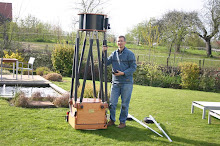
My wife loves me! She gave me as a present a clear night on Valentines day, and not only this, she let me observe!
The sky is indeed clear, although not very transparent. It’s difficult to see all the stars of the little dipper. I estimate it’s just nelm of 5.0. The weather is still quite cold, this night is going to be below zero again.
Date: Valentine 2009
Location: Boutersem (at home)
Equipment: Obsession 18”
Eyepieces: 24mm; 16mm, Powermate 2,5x
Nelm: close to 5.0
Seeing: moderate
Time 21:30Hr UT to 0Hr15 UT
Temperature: below zero
I was wondering if I was going to have the same kind of issues during start up like last time. This time not, the battery of the Argo Navis was fully charged, and the altitude cable was hanging loose. Quikc start this time.
The warm up exercises were M1, M42, M43 (nice, but less structure as last time), M78.
And now the real work with Herschel II. I expect this to be tougher due to somewhat worse conditions that usual. I intend to start with Draco:
NGC 4236 is a huge galaxy of 23’ which I have not been able to see.
NGC 4250 – galaxy in Draco
Observed at 124x, this is a round spot of 2’ with a moderate bright core. It’s located north of a triangle of 3 starts, of which one seems to be red.
NGC 4256 – galaxy in Draco
NGC 4256 is a nice edge-on galaxy, in the form of a needle. It’s 4’ long and less than 1’ wide. The core is bright (124x). The view is even nicer at 211x. The core seems to be a bit wider.
NGC 4133; 4291; 4319– galaxy in Draco
At 124x NGC 4133 is an oval of 2’ with a faint core. I can see it only with averted vision around 90% of the time. Located 20’ north of a bright star. More to the east is NGC 4291, which is an oval of 2’ in which 2 faint stars are visible. NGC 4319 was not visible at 124x, which confirms that conditions are not too good, as I have seen this object quite easily previously. However at 211x I can see it as an oval of 3’ without core.
NGC 5879 – galaxy in Draco
NGC 5879 is still quite low in the sky. I can see this galaxy with averted vision as an oval spot of 3’. Maybe a hint of a very faint core.
Looked for the 2 missing Herschell II objects in Puppis. NGC 2467 is still too low. NGC 2525 is high enough in the sky, but I cannot see it, nor at 124x, 211x or 316x. This must be a difficult one as no-one has seen this object in deslog.
NGC 1980 – nebula in Orion
Could not see the nebula around iota Ori. This bright start is a nice triple star (2 faint companions)
NGC 2639 – galaxy in Uma
NGC 2639 is at 124x an almost round spot of 2’ with a large bright core
NGC 2756 – galaxy in Uma
NGC 2756 is at 124x an almost round spot smaller 2’ without any core. It’s visible only 80% of the time.
NGC 2805; 2820; 2814 – galaxy in Uma
NGC 2805 is a very difficult target. I think I have seen it during at 124x a few moments but I’m not totally sure. I will have to redo this observation. To the NE is a very nice edge on galaxy of 6’ x 1” (NGC 2820). No core visible. At 211x NGC 2814 is visible as an elongated spot of 1’, close to a bright star.
NGC 2880 – galaxy in Uma
NGC 2880 is at 124x a bright galaxy. It’s an oval of 2’ with a bright core, which seems to be slightly off centre.
NGC 3073; 3079 – galaxy in Uma
NGC 3073 is located close to NGC 3079. This last one is very nice object which I had observed also in December 2008. It’s the famous galaxay which is bended towards the east. At 124x, this bending was visible during this night of not so good conditions. A little bit to the west is NGC 3073 which is a round spot of 1’, only visible at 211x.
NGC 3065; 3066 – galaxy in Uma
At 211x these 2 galaxies are in the same FOV. NGC 3065 is 2’ with a bright core. NGC 3066 is smaller, fainter and has no core.
NGC 3225 – galaxy in Uma
This is a difficult one at 124x. I have seen it only during a few short moments. At 211x it’s visible 80% of the time as an oval spot of 2’.
NGC 3319 – galaxy in Uma
Another difficult galaxy in Uma. I can see it during short moments as a large but very faint smudge of light of 3’ (124x)
NGC 3359 – galaxy in Uma
At 124x this is an easy object. It’s a large oval of 4’x2’ with maybe a faint core.
NGC 4271– galaxy in Uma
At 124x this is a round spot of 1x with stellar core.
NGC 4290– galaxy in Uma
At 124x this is an oval spot of 2’, without core. NGC 4284, 5’ west, is not visible, not even at 211x.
Up to here for the quite Herschell II list. I ended the night with some show pieces such as M81, M82, M46 and its planetary nebula, M35 (beautiful !!!), Eskimo, NGC 2172 (planetary in Gemini)
It was cold, conditions where not great, but at the end I was once more happy to have seen so many new objects.
HII: 195/400
Sunday, February 15, 2009


Saturday, January 31, 2009
First session in 2009 - one of the most productive
January 30, 2009
This is the 1st observation session of 2009. Jan and I went to observe a couple of hours in Roosbeek, where we enjoyed a very clear sky, probably close to nelm of 5.5. I had some troubles to start with such as a weak battery for the Argo Navis. It did power up but had an erratic behavior. Luckily Jan has some spare batteries I could use. The next issue was related to the azimuth encoder. It did not provide any signal to the AN, which was due to the cable. Not well connected in the AN due to too much stress on the cable. But once those issues were solved I could start a very productive session, with an observation of 49 deepsky object (including showpieces), 3 comets and Saturn. A lot of observed objects resulted with a quite poor description. You cannot get them all …
Location: Boutersem (Charly)
Equipment: Obsession 18”
Eyepieces: 24mm; 16mm, Powermate 2,5x
Nelm: close to 5,5
Seeing: moderate
Time 23:00Hr UT to 2Hr00 UT
Temperature: -2°C
First some showpieces, then we’ll go ahead with Herschel II
M42 – M43 – orion nebula
I’ve never seen M43 that well. The nebula is split in 2 by a dark lane. The southern part, in which a bright star is located, has some structure, the most obvious part being east from the star. (124x)
NGC 1977 and NGC 1973 – running man nebula
Easy to see. NGC 1973 is a nice round nebula around a bright star. Same for NGC 1977, which is bigger. Did not look for NGC 1975.
M46 and NGC 2438 – open cluster with planetary nebula in Puppis
At 124x the ring shape of the planetary is easily noticeable. A faint star is visible close to the centre.
Eskimo Nebula
M35 and NGC 2158
NGC 2158 is resolved at 124x.
M1
I find this object usually dull, but tonight it’s different. It’s well visible and the shape is irregular. An uneven surface brightness inside the nebula can be glimpsed. A few stars are visible at the northern edge. No filaments were visible. On a night like today I should redo this object and spend more time on it.
NGC 3156 – galaxy in Sextans
The only Herschel II object in Sextans is a galaxy of mag 12.1 located a few minutes NW from a bright star. It’s not an easy one aat 124x as I can glimpse it only 80% of the time. It’s an oval of 2’ without core. 30’ north east are 2 nice galaxies: NGC 3169 is with its 2’ almost round and has a bright core. NGC 3166 is larger (3’) and is an oval with a very bright core. NGC 3165, mag 13.9, was not visible, not even at 211x. This is not totally surprising as the contrast reserve is -0.22.
NGC 3158 – galaxy in Leo Minor
Leo Minor contains 4 Herschel II objects of which one I have already seen. Tonight we go for the other 3 ones. NGC 3158 is an easy target at 124x. It’s an almost round smudge of 2’ without core. To the south there are 2 other small galaxies of which NGC 3163 is easy to see. It’s a round spot without core. The 2nd one is NGC 3159 and is very difficult at 124x. It looks quite stellar. 211x gives a more comfortable view. Now NGC 3159 is visible as a round spot with a core. The core of NGC 3163 becomes also visible at 211x. South from NGC 3158 is NGC 3160, which was only visible at 211x, but remains difficult. It’s a very thin galaxy, like a needle, of 2’ long located between 2 bright stars. Unfortunately I did not look for the other galaxies in the neighborhood because they were not printed on my finder charts (too low power).
NGC 3254 – galaxy in Leo Minor
This is a “stand alone” galaxy in Leo Minor. Observed at 124x it’s a large oval spot of 3’ with a small, moderately bright core. 2 bright stars located at its east.
NGC 3424 – galaxy in Leo Minor
NGC 3424 is an elongated galaxy with a faint star on its east ends (124x). AT 211x the galaxy becomes longer and is extending further than the little star. So in reality, this star is located on NE edge on the galaxy, somewhere in the middle between the centre and the end. 5 minutes NE is NGC 3430, which is a large spot of 4’ without core (124x). On the opposite side of NGC 3424 is NGC 3413, which I could see only at 211x. It’s an elongated spot of 1’ without core. Finally there is a nice pair of galaxies on the west side of 3424, NGC 3395 and NGC 3396, or Arp 270. These are 2 oval spots quite uniform in brightness, both with a stellar core. NGC 3395 is somewhat larger than its twin brother. Both galaxies are forming an angle of 100°.
NGC 2269 – open cluster in Monoceros.
NGC 2269 was the only Herschel II object missing in Monoceros. It’s a open cluster of 5’. It’s composed of an NE stroke of 5’ long, containing 10 bright and moderately bright stars. NE are a few more stars (5).
NGC 2283 – galaxy in Canis Major
It’s 2nd time I’m hunting this one, but again, I cannot see it. It must be indeed a difficult one, because there are no logs in dslog. I guess this will be something for in the Provence.
Now follows a long list of galaxies in Uma
NGC 3516 – galaxy in Uma
NGC 3516 is at 124x a small but bright nebula of 1.5’ with a bright core. It’s located between 2 bright stars.
NGC 3583 – galaxy in Uma
NGC 3583 is a large bright nebula of 3’ with a faint core. NW is NGC 3577 which I can see at 211x. It’s a small round spot of 1’. Difficult object.
NGC 3622 – galaxy in Uma
At 124x, NGC 3622 is an elongated nebula of 1,5’. A very bright star, 20’ south, is interfering with the observation.
NGC 3642 – galaxy in Uma
This is a large bright nebula of 2’ with an obvious core. 35’ SW is NGC 3610, a galaxy of 2’ with a prominent core (124x). I saw this one with my 20cm in 2007.
NGC 3652 – galaxy in Uma
At 124x this is an easy one. It’s a 2’ elongated nebula (4:1) without core.
NGC 3669 – galaxy in Uma
(124x) NGC 3669 is a nice elongated nebula (5:1) of 2’ long. No core. To the west there are 3 other galaxies. NGC 3625 is an elongated spot of 1’. It’s a difficult target. NGC 3619 is a round spot of 2’ with bright core. Finally, NGC 3613, a bit towards the north, is very bright oval galaxy with an extremely bright core. It looks similar to M31. I have a little anecdote here: realizing this was similar as M31, an observation I did with my 20cm popped up in my mind. During this nights observation I remember I saw once an object also very similar to M31, so I was wondering if this would be the same galaxy. And yes, my note in http://www.deepskylog.log/ from 21/02/2007 is indeed confirming this. It’s funny that even after observing 1000th of different objects and having seen most of them only once, there are some of them stored for ever in my memory.
NGC 3668 – galaxy in Uma
An easy to observe oval of 2’ with a faint but large core (124x)
NGC 3683 – galaxy in Uma
(124x) An easy elongated spot of 2’ with a faint core. I did not look for the galaxies in the neighborhood.
NGC 3756 – galaxy in Uma
(124x) NGC 3756 is a large but blurred oval of 4’. It’s in same FOV as NGC 3738, smaller and brighter as NGC 3756 but still large with its 3’ length. It looks like it has a bright small core a bit off centre. Further north is NGC 3733 which was only visible at 211x. Although it is 3’, it is so faint that I cannot determine the shape. It’s close to a disturbing bright star. I can see it only 10% of the time.
NGC 4013 – galaxy in Uma
(124x) NGC 4013 is an elongated galaxy of 3’ with something that looks like a star on the NE end. I’m not sure what it is because there is no star printed on my finder chart. This is a strange observation because this is not corresponding to other observations. Or I’m getting tired and I’ve seen only half of the galaxy (the star being in fact the bright core), or I’m looking to a wrong object (which I don’t believe).
NGC 4047 – galaxy in Uma
(124x) Small round spot of 1’ with a faint core.
NGC 4062 – galaxy in Uma
(124x) WOW! A very nice, large galaxy of 5’ with thick central area and 2 tapered ends. These 3 area’s are all equal in size. Uniform brightness.
NGC 4096 – galaxy in Uma
(124x) This is again a nice elongated galaxy of 5’ with two tapered ends. Interestingly, the core is not located centrally but more to the north. The SE side of the core is thicker than the other side. It’s really not a symmetrical galaxy. The core contains a stellar nucleus.
NGC 4100 – galaxy in Uma
(124x) NGC 4100 is also an elongated galaxy of 5’ (4:1). A nice object which I had already seen with my 20cm.
NGC 4144 – galaxy in Uma
(124x) An elongated galaxy of 5’. The southern edge (which is maybe the core) is brighter and uniform in brightness. An interesting object.
NGC 4157 – galaxy in Uma
(124x) Once again, a spectacular edge on galaxy. This one is 6’ large and has an elongation ration of 5:1. Brightness is not uniform. Core looks slightly positioned more towards the east.
This concludes the quest of Herschel 4 objects. Like always I like to end with showpieces.
M82 (and M81): unbelievable what I can see. A prominent dark line a lots of structure and bright knots.
M51: The 2 spiral arms are clearly visible with some bright knots in each of them.
NGC 4565: edge-on in Coma – dark lane is visible
Hickson 44 (in Leo). The 4 galaxies are visible. NGC 3193 and NGC 3190 are easy. I see NGC 3185 only from the moment when Jan tells me where to look. And NGC 3187 is a faint but doable object.
Saturn
We ended the night with an observation of Saturn. The rings is almost edge on which is a spectacular view. At 500x the ring in front of the planet is visible as a fine line. At least 3 moons are visible.
During the night I saw also 3 comets through the scope of Jan.
Sunday, January 4, 2009
Several eyepieces for sale
-


On the rear row, from left to right:
2” oculair 28mm Multi-coated – not branded - Price: €35
I've won this eyepiece on a quiz during deepsky day in Nijmegen (NL) - used only twice
1 ¼” Celestron Plössl – 32mm – fully multi-coated - New: €57 Price: €42
1 ¼” Celestron Plössl – 15mm – fully multi-coated - New: €45 Price: €33 (SOLD)
1 ¼” Celestron Plössl – 6mm – fully multi-coated - New: €45 Price: €33 (SOLD)
1 ¼” Celestron Plössl – 4mm – fully multi-coated - New: €45 Price: €33
On the 2nd row, from left to right:
1 ¼” Oculair Baader Genuine Ortho 5mm - New: €98 - Price: €75
Used only once. This is a great eyepiece for planetary observations.
1 ¼” Meade Ortho 12,5mm – multi-coated - Price: €30
1 ¼” Meade Ortho 6mm – multi-coated - Price: €30
1 ¼” Lichtenknecker (?) Ortho 8mm - Price: €35
1 ¼” Lichtenknecker (?) Ortho 25mm - Price: €35
On the front row:
Celestron 2x Barlow New: €57 - Price: €42 - (SOLD)
-
Prices are excluding shipping costs. Cash payment or payment in advance.
-
If interested please leave me a comment including your email.
Wednesday, December 31, 2008
Last Deepsky Night of 2008!
Although it’s again clear this evening I was not really planning to observe. I felt a bit tired. Luckily Jan V. called and we decided to go observing together again at the place of Charly. I needed this little push by Jan to go out for the 5th observing session this week. And it was a good thing (thanks Jan!) – the night was again very clear (but cold too). We’ve been observing until 2UT.
Location: Boutersem (Charly)
Equipment: Obsession 18”
Eyepieces: 24mm; 16mm, Powermate 2,5x
Nelm: 5,2
Seeing: moderate
Time 23:00Hr UT to 2Hr00 UT
Temperature: -6°C
The objective of the day is again the Herschel II list.
NGC 2253 – open cluster in Camelopardalis.
This object does not exist! Really, see the discussion on:
http://www.cloudynights.com/ubbthreads/showflat.php/Cat/0/Number/2404095/page/0/view/collapsed/sb/5/o/all/fpart/1#Post2832842
I was looking at the right place, but there is nothing to see.
NGC 2347; IC 2179 – galaxies in Camelopardalis
NGC 2347 is continuously visible at 127x. It’s an oval spot of 2’ without any core. It’s located on one of the edges of a triangle of 3 bright stars. 15’ north is IC 2179. Also this one is continuously visible at 127x. It’ has a round shape but is a bit smaller than NGC 2347. A faint core is visible.
NGC 7245 – open cluster in Lacerta
At 211x I can see with averted vision the glow of unresolved stars and something like 5 faint stars, on an area on 5’. The cluster is located in rich area of stars. Visibility is better at 316x. A small but nice asterism with a shape of a keystone is located 8’ north of the cluster.
NGC 1207 – galaxy in Perseus
I have tried this one with my 20cm Newton but without success. With the 18” it’s an easy galaxy at 124x. The oval is 2’ long and 1’ wide and contains a faint core.
I still need to do 3 Herschel II objects in Pisces, but it’s going to be a challenge – Pisces is currently located (SW) in an area where there is quite some light pollution. I’m not quite sure this will work but let’s try it out.
NGC 706 – galaxy in Pisces
This is galaxy of mag 12.5. In this light pollution it’s quite tough. I can only see it at 211x and not even continuously (80%) as a oval spot of 2’, without any core. I’m not going to try the galaxies in the neighbourhood because it does not make sense in these conditions.
NGC 718 – galaxy in Pisces
This is galaxy of mag 11.7 In this light pollution it’s quite tough. I can only see it at 211x and not even continuously (80%) as a oval spot of 2’, with a faint core.
NGC 741 – galaxy in Pisces
This is in fact a pair of galaxies (NGC 741 and NGC 742) of mag 13. 3. With this light pollution I can see only 1 round, but rather large oval of 3’ (larger than NGC 718 and NGC 706). It’s probably the combine light of the 2 galaxies, but I cannot make any distinction between the 2.
This is surely an observation to repeat in order to view the smaller NGC 742.
NGC 821 – galaxy in Aries
This one is easy, even at 124x. Located SE to a bright star. The galaxy does not touch this star. It’s 1’ large and contains bright core. Visible with direct vision.
NGC 890 – galaxy in Aries
NGC 890 is at 124x a bright galaxy of 2’ with a striking core. The core is as bright as the brightest star of a little triangle west of the galaxy. I’ve seen this one also with my 20cm Newton. At that time I could not see any core (but nelm was only 4.9)
NGC 925 – galaxy in Triangulum
NGC 925 is a huge galaxy in Triangulum. It’s visible at 84x but the best view is at 84x with Deepsky filter. I estimate the galaxy to be larger than 7’ and as wide as 3’. Three faint stars are close (in or out of the galaxy, difficult to say) to the galaxy. The galaxy is a bit brighter at its centre.
NGC 1012 – galaxy in Aries
NGC 1012, of mag 12.1 is already visible at 84x. At 124x I can see a large almost round spot of 2’ with a large but faint core.
NGC 1156 – galaxy in Aries
Observation at 124x. It’s a strange object of 3’. The shape is not really oval – it looks like a piece of the oval has been cut away. It’s maybe due to the 3 stars which are location the NW edge.
Beta Monocerotis
Observed with the 15” Obsession of Jan. A nice triple star (forgot to note the colours)
Now we go more south to Lepus
NGC 1832 – galaxy in Lepus
Observed at 124x. An oval of 2’ close to a moderate bright star. 2’ no core.
NGC 2196 – galaxy in Lepus
At 211x it’s visible 10% of the time, between 2 faint stars. It’s an almost round spot of 2’.
NGC 2139 – galaxy in Lepus
Very very difficult but I have been able to see it during a 5 short moments as a large spot, both at 211x and at 316x.
The next objects are in Puppis
NGC 2396 – open cluster in Puppis
A very loose open cluster. 10 bright stars in an area of 10’. There is north of the cluster a nice double star with orange and blue colors.
NGC 2414 – open cluster in Puppis
At 211x I see 1 bright and 6 faint stars in an arc of 5’. Located SE of straight line of 4 bright stars.
NGC 2432 – open cluster in Puppis
At 211x I see 15 stars (moderately bright and faint ones) in an arc of 5’, going north south.
I looked for NGC 2525 – a galaxy in Puppis, but I’m not sure I have seen it.
NGC 2467 – open cluster with nebulosity in Puppis.
This object is still very low, less than 10°. I can see at the right location 1 bright star and 10 faint stars. This is the open cluster. I could not see any nebulosity. Observation at 211x. Will need to redo this observation.
At this moment I have enough to see all these faint HII objects. It’s time for some show pieces.
NGC 2438 – planetary nebula in M46 – Puppis
Fantastic at 211x and 316x. This is a large disc! One star on the disc, but off centre is visible at 211x. A 2nd star becomes visible at 316x, still off centre. A bright star is located at the SE edge. With averted vision a ring structure (dark centre) becomes visible.
NGC 2440 – planetary nebula – Puppis
NGC 2440 is another planetary in Puppis. It’s a very bright disc. At 316x I can see a curl on the western edge. Nice object.
Looked also at Eskimo (once more!) and NGC 2371 (idem, once more).
Tried to look for the supernova in M61 but at 2Hr UT the galaxy is still too low .
I have seen the Medusa Nebula through the 15” scope of Jan (with OIII filter).
NGC 3079 – galaxy in Ursa Major.
I ended the night with a fantastic object, NGC 3079, a galaxy in Ursa Major. It’s a long streak of 5’ (elongation around 1:7) with a very bright core of 1” which is offset toward the east. Due to this offset, the galaxy looks bended! Observation at 211x.
This ends a very nice observation night.
162 / 400 Herschel II objects.
Tuesday, December 30, 2008
Observation session with Jan V on Dec 29, 2008
The 4th observation night but not alone this time, as Jan V. joined me to observe during a few hours. It’s again one of those cold nights, the ServoCat of Jan was indicated -6° at midnight.
Location: Boutersem (Charly)
Equipment: Obsession18”
Eyepieces: 24mm; 16mm, Powermate 2,5x
Nelm: 5,2
Seeing: moderate
Time 22:30Hr UT to 0Hr30 UT
Before the real observing work started I had the visit of Charly and Sebastien. Charly, the oncle of Caroline, is the owner of the piece of ground were we are currently observing. They had the opportunity to see a couple of deepsky objects through the 18” Obsession. We started of course with easy objects and went to a bit more difficult targets. They’ve seen M42, M37, M35, M81 and M82 (dark lane seen), M76 (they noticed the peanut shaped) and ended with M34. 7 Messiers in half an hour. Not bad I would say.
Around 23:30 UT I could start observing the Herschel II list. I still have one object to do in Cepheus. But the major part of the evening will be open clusters and nebula’s in Monoceros.
NGC 7139 – planetary nebula in Cepheus
Bad planning, as I had already seen this one in the Provence. Anyway, here at a Nelm 5.2 sky it’s a difficult object. At 211x I can see a very faint disc of 1’, with a faint star at the NE edge. An UHC enhances the visibility. The southern edge seems to be brighter, which is confirmed on the DSS picture.
NGC 1663 – open cluster in Orion
This is a very loose cluster in Orion. Also this one is badly planned, as I had seen it with my 20cm scope earlier this year. I absolutely need to update my HII list! At 124x I see 4 bright stars in an arc. It’s not even sure if these stars are part of the cluster. North of this arc there are 7 faint stars in an area smaller than 10’. No more stars at 211x.
NGC 2170 – reflection nebula in Monoceros
A little round nebula around a bright star, visible at 84x and 211x, without any filter. No glare.
NGC 2182 – reflection nebula in Monoceros
This is not glare, but a nebula around bright star. Visible at 211x.
NGC 2236 – Open cluster in Monoceros
A small open cluster of less than 10’. At 211x 15 faint stars are distributed in a triangular shape. A bright star is at the western edge. An ars of 4 bright stars is located 5’ east of the cluster.
NGC 2245; NGC 2247 – reflection nebula in Monoceros
Close to the Xmas cluster we find a beautiful little nebula. It has a triangular shape. A bright star is located at one of the Northern corner of the triangle. The southern edge is more diffuse than the 2 other edges. Also the brightness is increasing in the direction of the star. Observation at 211x. This nebula reminds me of Hubbles variable nebula. NGC 2247 is located 20’ north of NGC 2245. This one is more difficult. With averted vision a faint nebula of 2’ is visible around a bright star. This is no glare because the view is different when compared to another similar bright stars.
NGC 2252 – open cluster in Monoceros
This is a large open cluster of 20’. With a lot of fantasy, I can see it like a fish with a big tail. There are 20 bright stars and only a few faint ones (211x). This cluster is located just north east of the Rosette nebula.
NGC 2254 – open cluster in Monoceros
A small open cluster with 6 moderately bright stars distributed on an arc. 5’ large. There is a glow of unresolved stars (211x)
NGC 2259 – open cluster in Monoceros
Another small open cluster in Monoceros. In an area of 5’ I can find with averted vision 15 very faint stars (211x). A fun object!
NGC 2302 – open cluster in Monoceros
A loose open cluster with 8 bright stars in an area of 5’. Observation at 211x.
NGC 2309 – open cluster in Monoceros
This is again a loose opne cluster. At 211 I can see 20 stars in an area of 10’. 7 of them are quite bright, the rest are faint.
NGC 2316 – reflection nebula in Monoceros
A cute little nebula. At 316x it’s a small but bright nebula. Il looks like it’s made out of 2 more or less round parts. The centre looks brighter but it could also be a star. Becomes less visible with UHC filter.
Ended this very cold night (-6°C and I’m starting to get real cold) with Eskimo, M81, M82, M107.
146 Herschel II objects.
Observation Dec 28, 2008
The 3rd observation night. It’s colder than last time, somewhat around -5 or -6°, but strangely, I don’t feel it like that. I had less cold this night than the previous time.
Location: Boutersem
Equipment: Obsession18”
Eyepieces: 24mm; 16mm, Powermate 2,5x
Nelm: 5,0
Seeing: moderate
Time 21:30Hr UT to 0Hr30 UT
I observed for about 3 hours and then I had to stop due to an issue with the ServoCat. The engines were not responding anymore.
The objective of this night is to continue with Herschel II; have another try at the emission nebula in Auriga, and to stop with some showpieces. But first and Arp to start with.
I started with M37 and M1.
NGC 93 – Arp65 – galaxies in Andromeda
This Arp group contains 2 galaxies, NGC 91 and NGC 93. I could only see NGC 93 but only with a lot of efforts. I can see it only 10% of the time. It’s so faint I cannot determine if it’s round or oval. It’s 1’ and has no core. NGC 91 was not visible. More to the west are 2 easier galaxies: NGC 83 is a round spot of 1’, located close to a small triangle of bright stars. No core. NGC 80 is also a 1’ round spot, but here it seems to have a stellar core. Observations at 211x.
Before going for the Herschel II I tried the emission nebula in Auriga:
IC 405 – flaming star – Auriga
I’m convinced I have seen nebulosity (with the help of an UHC filter) around the bright star located 10’ NW of AU Aurigae. It looked like a triangular shape located NW of this star – see drawing. Most observers are finding nebulosity around AE Aurigae, but I did not see anything except for the glare. I need to develop a technique to notice the difference between glare and nebulosity.
IC410 – emission nebula - Auriga
Again, the C-shape was clearly visible. This is an easy nebula
IC 417 – emission nebula - Auriga
I think I saw some faint nebulosity (with UHC) around the triple star in the middle of the Stock 8 cluster.
Next observations are Herschel II objects.
NGC 410; NGC 414; NGC 407 – galaxies in Pisces
NGC 410 is not visible at 124x. I need 211x to see it as a round nebula of 2’, without core. It’s quite easy at this power. SW is NGC 407, an elongated galaxy (3:1) of 2’. There is not core. Only 20% of the time visible. On the other side of NGC 410 is NGC 414. This is an easier target than NGC 407 although it’s a smaller one with its 1’. Here also no core is visible.
NGC 428 – galaxy in Cetus
At 211x I can see this stand alone but large nebula whose shape is difficult to determine. Visible only 20% of time.
NGC 514 – galaxy in Pisces
Again a stand-alone galaxy, this time in Pisces. Also this one is difficult as I can see it only 20% of the time at 211x. It’s a large round nebula of 3’, without core.
NGC 636 – galaxy in Cetus
This is a very easy galaxy, visible with direct vision even at 124x. It’s 3’ large, round but has no core.
NGC 660 – galaxy in Pisces
NGC 660 is a huge galaxy of 6’ and very easy to see. It’s oval shaped and has no core.
NGC 665; IC 156; IC 154– galaxy in Pisces
This is a little group of 3 galaxies in Pisces which has not yet been logged in www.deepskylog.be . NGC 665 is relatively easy at 211x as it is continuously visible. It’s an oval of 2’ with a core. IC 156 is located NE of NGC 665 and is a small round spot of 1’. A bit further north is IC 154 which is extremely difficult. I could see at 316x only a few times an elongated smudge of light. A moderate bright star is located at the southern edge. Check the DSS picture, its quite nice!
NGC 1184 – galaxy in Cepheus
NGC 1184 is one of the few galaxies in Cepheus. At 124x it’s visible with direct vision. It’s an elongated nebula of 2’ (elongation 3:1) with a bright core. See also DSS picture for this nice galaxy.
NGC 1175; 1177; IC 284 – galaxies in Perseus
A trio of galaxies in Perseus which is located 2° NW from Perseus A cluster. NGC 1175, which is an easy one, is visible as oval spot of 2’ at 124x and has a faint core. NGC 1177 is very difficult. I’ve seen it only a few moments at 316x. It’s smaller than 1’. IC 284 is visible half of the time at 211x. It’s a large oval of 5’ and has no core.
NGC 4291; 4319; 4386 – galaxies in Draco
NGC 4291 is a very nice object. It’s a bright round spot of 2’. There is a faint star on the nebula, and another one at the western edge. I did not notice the 2nd star at the western edge. It’s located very close to a small triangle of bright stars. NCG 4319, 5’ SE of NGC 4291 is an oval of 3’. NGC 4386, mote to the NE, is bright oval of 2’, visible with direct vision. The core is visible too.
I ended with Eskimo nebula, and NGC 2371, another planetary in Gemini. I could see the central star (I did not notice this last time).
At this time the Servocat was not functioning anymore so I decided to stop. It was once more a very nice observation session.
I have seen 136 Herschel II objects.
Saturday, December 27, 2008
Observation December 26, 2008
The 2nd clear night in a row. Transparency is a bit less than yesterday but it’s still OK with nelm of 5.0. It’s however much colder. I guess it’s -4°C., which is doable for a few hours.
Location: Boutersem
Equipment: Obsession18”
Eyepieces: 24mm; 16mm, Powermate 2,5x
Nelm: 5,0
Seeing: moderate
Time 19Hr UT to 24Hr UT
I started with M37, as usually during winter time.
Spend some time looking for the nebula in M45, but except some glare around the brightest stars I could not see any hint of it.
M76 is a fantastic object. Lot’s of details to see, as well as some brightness differences. Could see the brightest part of the outer halo.
Cat’s Eye and IC 4677 – planetary nebula in Draco
Tried to look for IC 4677 which is according to some sources a galaxy, and to other sources a bright patch of the outer shell of the Cat’s Eye. After looking at the DSS picture I’m choosing for the 2nd option. It’s a difficult object in mag 5.0 sky. I have seen it a little while at 211x. It reacts positively to an UHC filter, as now I could see it during 10% of the time.
Now we go for HII objects.
NGC 7419 – open cluster in Cepheus
Small concentrated cluster containing 10 stars in an area of 7’. It’s located in line of 2 bright stars. At 211x 20 stars are visible; many of them are quite faint. Cute little cluster.
NGC 7600 – galaxy in Aquarius
124x: oval smudge of 2’ with a small but bright core. Averted vision required. Visible 50% of time.
NGC 7785 – galaxy in Pisces
124x: This is an easy object. It’s located in the middle of a triangle of 3 bright stars. NGC 7785 is an oval of 2’ and has a faint core.
I did not found NGC 7832, galaxy in Pisces
NGC 23 and NGC 26 – galaxies in Pegasus
NGC 23 is very easy. I can see it with direct vision at 124x. It’s a smudge of 2’ with a bright core. A faint star is located close to the eastern edge. NGC 26, located 10’ SE of NGC 23 is much more difficult. Only 20% of the time visible at 124x. It’s a smudge of 1’. It becomes a bit better visible at 211x.
NGC 125; 126; 128 – group of galaxies in Pisces
NGC 125 is the Herschel II object. With averted vision at 124x it’s a small smudge, smaller than 1’. A nice double star is located south of the galaxy. NGC 128 is a nice edge on galaxy of 3’, with an elongation of 4:1. No core. NGC 126 is difficult. I could only see it a few times at 211x. NGC 127 and 130 were not visible.
Worthwhile to redo!
NGC 151 – galaxy in Cetus
A large object of 3’ but only visible 10% of the time, at 124x. The visibility increases a lot at 211x. NGC 163 which is located SE of NGC 151 was not visible.
NGC 182; 186; 193; 194; 198; 199; 200; 204 – group of galaxies in Pisces
NGC 198 is the Herschel II object. It’s oval an easy to see at 124x. NGC 200, located 7’ north, os a faint large oval of 2’, visible at 211x. No core. Continuing north are more galaxies. NGC 194 is easy to see at 211x. It’s round, 1’ and has a faint core. NGC 199 is more difficult. It’s an oval visible only 20% of the time. More north is NGC 193, an oval galaxy without core close to a faint star. Visible half of the time. NGC 204 is located east of NGC 193 and is also a bit smaller than NGC 193. No core. NGC 186 is more to the west. This oval of 1’ without core is almost continuously visible. 15’ east of NGC 198 is NGC 182, a very faint galaxy. NGC 208, west of the Herschel II object was not visible. NGC 202 and 203 were not on may finder chart, so I did not look for it L
NGC 217 – galaxy in Cetus
NGC 217 is an elongated galaxy of 2’ (elongation 3:1) without core. At 124x it’s visible 80% of time. This galaxy has not yet been observed in dslog.
NGC 315; 311; 318 – galaxy in Cetus
NGC 315 is a an easy object. At 124x it’s round, has core, and is larger than 2’. NGC 311 is also visible at 124, but the core appears only at 211x. Is 1’ long. NGC 318 is a stellar object at 211x located east of a faint star.
Up to here the faint Herschel II objects. It’s time to do something else. I wanted to redo some observations in Auriga.
IC 410 – emission nebula in Auriga
I looked at this one also yesterday. The C-shape is very clear. The C is wider and brighter at its west side. Nice object.
IC 405 – flaming star – Auriga: looked for a while, but could not see any nebulosity, apart from the glare around the brighter stars.
IC 417 – emission nebula in Auriga
Yesterday I was not very sure I have seen the nebula. Today, I still cannot confirm at 100% Maybe I have seen some nebulosity (with UHC) but it’s far from being sure.
NGC 2392 (Eskimo) – planetary in Gemini
I wrote it yesterday that I need to look for the concentric ring within the inner disc. (I also wrote to look for the colors, but I forgot to do this). Well, I’ve seen the concentric ring. So there 3 distinct area’s: The outer halo, a triangular shaped inner disc, and a concentric ring, and of course the central star. Those 3 areas are best visible at 316x with filter. But without filter it remains slightly visible. During a few moments I thought I could see some structure in the halo (2 dark area’s, each of them ¼ of a circle).
NGC 2371/72 – planetary nebula in Gemini
A double lobed planetary nebula (peanut shaped). It’s quite impressive in the 18” at 211x with UHC filter. The SW lobe is the brightest one and contains a bright area. The NE lobe also contains at its eastern edge a brighter area. The centre (the area between the 2 lobes) is dark. Nice object.
I’ve been spending almost 4 hours in the cold, time to get inside. Quite glad of this evening session.
Subscribe to:
Posts (Atom)